
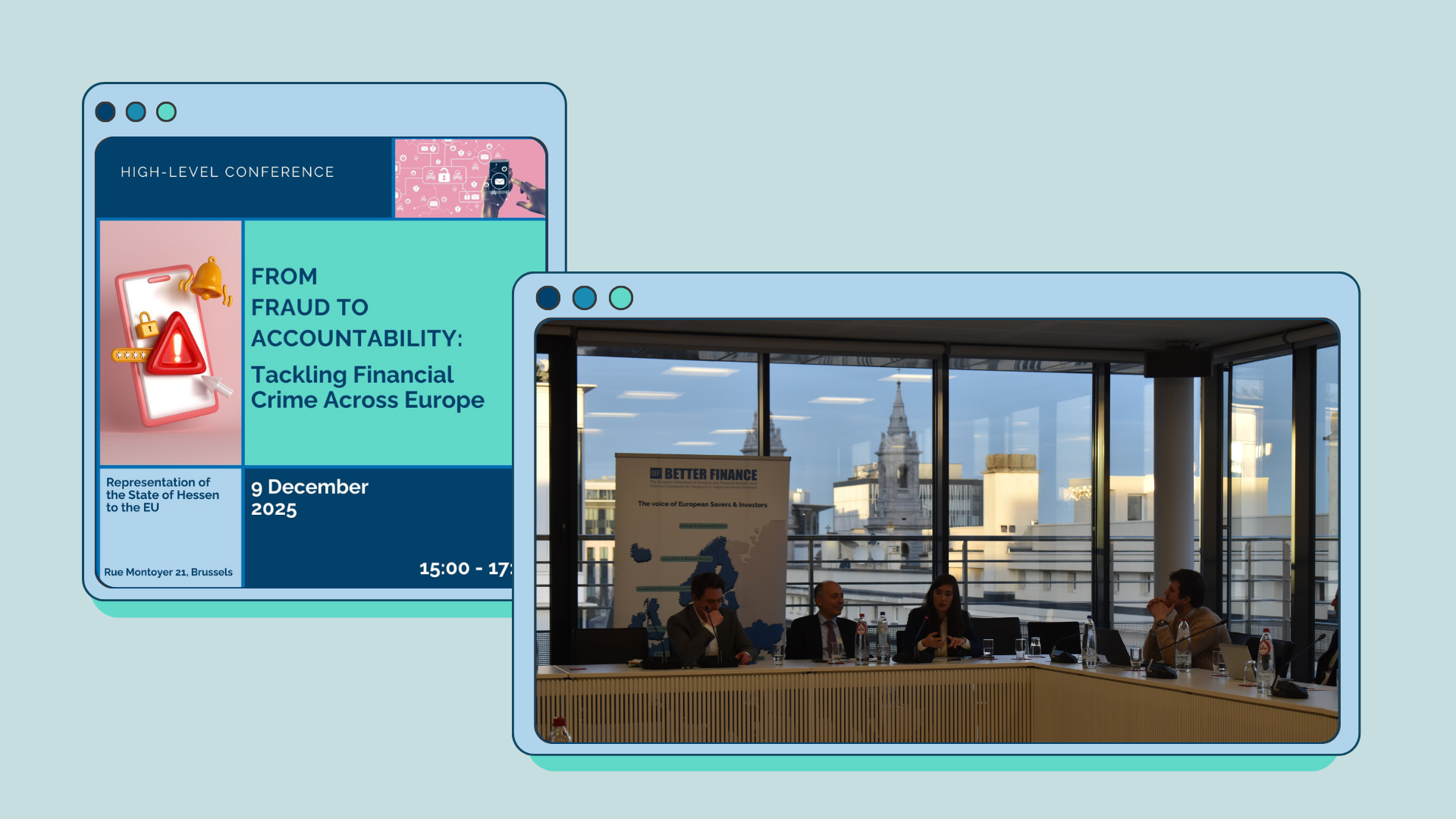
Financial fraud and investment scams are rapidly evolving threats that undermine trust in Europe’s financial system and inflict significant harm on individual investors. Against this backdrop, BETTER FINANCE convened the conference “From Fraud to Accountability: Tackling Financial Crime Across Europe”, bringing together policymakers, regulators, market experts, and consumer representatives to examine how fraud is changing and why Europe's response must become faster, more coordinated, and more effective.
Held at a critical moment for EU financial reform, the event focused on the growing scale and sophistication of cross-border scams, the challenges of enforcement in a digital and fragmented market, and the persistent gaps in investor protection and redress.
Understanding the mechanics of modern investment fraud
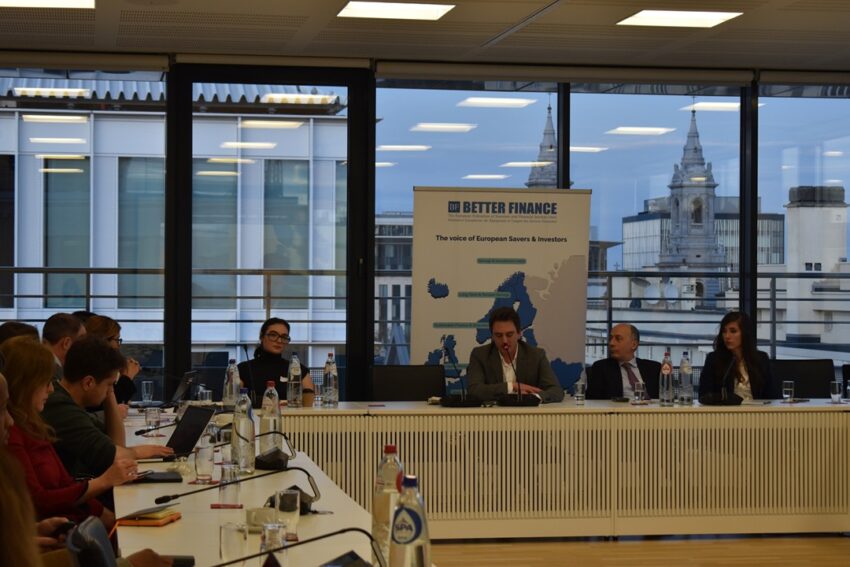
The panel discussion examined the scale, complexity, and human impact of investment fraud in Europe, bringing together representatives from civil society, European and international regulators, fintech, and data-driven market actors. The discussion highlighted that investment scams have become increasingly sophisticated, cross-border, and industrialised, requiring coordinated action well beyond traditional regulatory approaches.
Opening the discussion, the moderator of the panel, Martin Molko, Research & Policy Officer at BETTER FINANCE, stressed that fraud is no longer a marginal issue but a systemic risk affecting millions of European citizens, particularly retail investors targeted through online scams, impersonation fraud and social-media-driven schemes.
Andy Agathangelou, Founder of the Transparency Task Force and Chair of the UK All-Party Parliamentary Group on Investment Fraud and Fairer Financial Services, drawing on real-life cases, highlighted the severe human consequences of financial crime, including trauma, mental health impacts, and, in extreme cases, loss of life. He also underlined the systemic damage caused by fraud to trust in the financial sector, noting that persistent scandals and weak accountability have led many citizens to disengage from saving and investing altogether.
With a regulator’s perspective, Salvatore Gnoni, Head of Unit for Investor Protection and Intermediaries at ESMA, described the rapid evolution of online scams driven by digitalisation, artificial intelligence, and the growing role of unregulated actors such as social media platforms and influencers. He emphasised that fraud today is primarily a form of social engineering, exploiting behavioural biases rather than technical vulnerabilities. Gnoni outlined ESMA’s response, including increased investor warnings, closer cooperation with EBA and EIOPA, engagement with major online platforms, and the use of tools under the Digital Services Act.
Zooming out to the international level, Kris Nathanail, Director of Standards Development (Policy) at IOSCO, underlined that fraud is inherently cross-border and therefore requires joint action across jurisdictions and sectors. In particular, she highlighted IOSCO’s education and collaboration efforts, noting that: “Fraud is global, but it won’t be sorted out solely through legislation. We need education. We need collaboration, both across borders and across industries, to mitigate it.” She also spotlighted IOSCO’s extensive investor education and awareness campaigns, including World Investor Week, which BETTER FINANCE is part of.

Moving into practical detection and disruption, from the perspective of the private sector, Zoltán Kormányos, Legal Counsel at BrokerChooser, provided a data-driven perspective on how retail investors encounter scams online. He explained how BrokerChooser uses regulatory warning lists, search engine optimisation, and user traffic data to identify the most harmful scam entities and make warnings visible where investors actually search for information. He noted that “the top 10 [scam] entities are actually producing 95% of the Google search impressions”, and warned that even when warnings exist, they may be effectively invisible if they surface too late in online search results.
From the financial sector frontline, Oleksandra Maksymenko, EU Government Affairs Manager at Revolut, noted that while investment scams represent a relatively small share of reported cases, they account for a disproportionate share of consumer losses. She explained how scammers increasingly rely on encrypted messaging platforms such as Telegram and WhatsApp and described the challenges banks face when intervening on behalf of victims under the influence of social engineering. Maksymenko stressed the importance of involving law enforcement and pointed to international best practices, such as Australia’s “fusion cells,” as an example of continuous, ecosystem-wide cooperation to combat scams.
Bringing the conversation to EU policy instruments, Raluca Prună Head of Unit for financial crime at the European Commission’s DG FISMA, outlined how current and upcoming EU files can work together—payments, AML and investor-protection rules—to reduce scam opportunities, improve traceability, and prevent criminals from re-injecting illicit proceeds back into the financial system.
The discussion concluded with a shared recognition that isolated actors or single policy tools cannot address investment fraud. Panellists agreed that effective prevention requires coordinated action across regulators, platforms, financial institutions, law enforcement, and civil society, combined with stronger accountability, better use of data, and a sustained focus on victims' needs.
Illicit finance beyond markets—the global gold connection
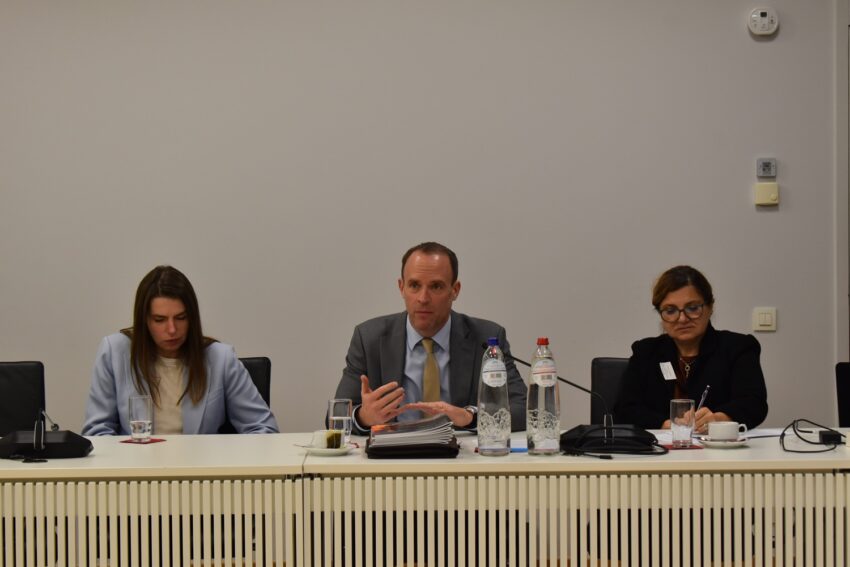
Dominic Raab delivered the keynote address on behalf of the World Gold Council, revisiting the findings of Silence is Golden, his 2024 report exposing the violent exploitation of artisanal and small-scale gold mining (ASGM) communities by mercenaries, terrorist groups and criminal networks. As he starkly put it, “The scale of violent exploitation... is only getting worse, because the business model is so lucrative.”
His intervention underlined that ASGM is no peripheral issue. It sits at the crossroads of illicit finance, conflict dynamics, environmental degradation and human exploitation, with criminal actors using illegal gold flows to expand their operations at alarming speed. Raab highlighted modest but meaningful progress, from emerging local processing models and Central Bank purchasing schemes to the new Global Coalition for Action on ASGM, yet stressed that “we now need to galvanise the political will” to match the scale of the threat.
This message resonated as Raab’s speech made the link to scams and investor protection, discussed during the panel discussion. The connection was unmistakable: whether in global gold supply chains or retail investment markets, opacity and weak enforcement create fertile ground for exploitation.
The theme “Silence is Golden” took on renewed relevance in this context. Silence, whether from regulators, policymakers or market participants, is precisely what allows fraud, illicit finance and predatory actors to flourish. From ASGM sites in Africa and Latin America to digital scams targeting European consumers, the same conclusion applies: transparency, accountability, and coordinated enforcement are indispensable.
Raab’s call for renewed action from the Financial Action Task Force (FATF) was particularly urgent. It has been a decade since FATF last reviewed the gold sector, despite its central role in global illicit finance. Updated guidance, stronger baseline standards, and greater scrutiny of gold-trading hubs are now overdue.
Europe has an opportunity and a responsibility to help lead this agenda. The conference’s discussions showed that expertise, tools, and frameworks exist. What is needed now is collective determination to turn early progress into systemic change.
What comes next
The conference underscored that tackling financial crime in Europe requires decisive political action, effective enforcement, and a stronger focus on investor and citizen protection. As repeatedly highlighted throughout the discussions, the European Commission has put forward important initiatives to address fraud, illicit finance and market abuse. The responsibility now lies with Member States to translate these proposals into concrete measures that strengthen supervision, close enforcement gaps, and ensure that criminals can no longer exploit Europe’s financial system with impunity.
BETTER FINANCE would like to thank the Representation of the State of Hessen to the European Union for generously hosting the conference at its premises and for its continued support in fostering informed dialogue among policymakers, regulators, law enforcement authorities, and civil society.